.png)
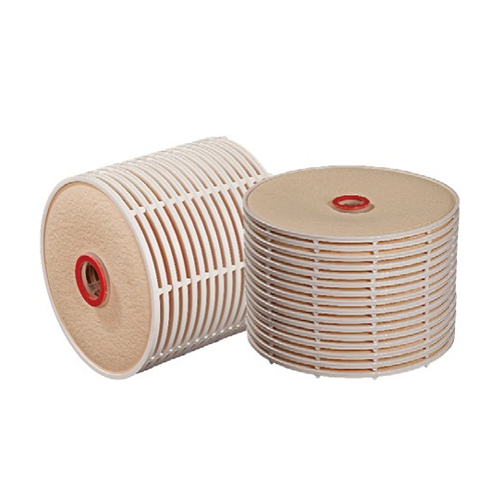
Activated Carbon Depth Filter Sheets
Request a QuoteDescription
Powdered Activated Carbon (PAC) plays a critical role in the chemical, food & beverage industries, where it is commonly used for decolorization, removal of undesired by-products, and correction of taste, odor, and color profiles. However, the use of traditional bulk PAC has significant drawbacks in terms of handling the bulk carbon powder, cleaning process equipment, and the time and costs associated with carbon removal from the process. In contrast, immobilized activated carbon provides significant advantages in handling, cleaning, and cost saving. Our Activated Carbon Series filter media alleviate these challenges by incorporating activated carbon within a robust matrix of cellulosic fibers, fully capitalizing on the benefits of immobilized carbon over conventional PAC. Moreover, AC Series immobilized carbon filter media exhibits superior adsorption efficiency compared to an equivalent amount of bulk PAC, significantly reducing overall process time and increasing product recovery.
Advantages of using Immobilized Activated Carbon vs. Bulk PAC
| Category | Bulk PAC Process | AC Series Filter Advantage | Key Improvements |
| Dusty&Safety | Dust generation; Potential health/safety risks |
Dust-free; No cleaning required. |
Eliminates fire risks; Improved health and safety. |
| Process Steps | Complex multi-step process | Single-step adsorption, decolorization,and filtration |
Reduces labor,lowers costs, shortens process time. |
| Process Times | Long prep,contact,and removal times. | Constant flow. Rapid adsorption. |
30-50%faster. Energy/resource savings. |
| Cleanliness &Maintenance | Residues require cleaning. Batch contamination risks. |
No residues. Minimal downstream filtration. |
Lower solvent costs. No cleaning downtime. |
Quality
- Filter sheets produced in a controlled environment
- Manufactured according to ISO 9001 certified Quality Management System
Food Contact Compliance
Please contact Membrane Solutions for a Declaration of Compliance to specific National Legislation and/or Regional Regulatory requirements for food contact use.
Applications
- Decolorization and removal of organic impurities in fine chemica
- Decolorization of sugar syrups
- Correction of taste and color in juice and beer applications
- Correction of off color, flavor and odors in distilled spirits
Adsorption Capability
The pore size distribution of activated carbon determines its specific adsorption mechanisms. Key properties such as iodine number, methylene blue adsorption capacity, and molasses number define its performance characteristics. Pore sizes vary between micropores, mesopores and macropores. Macropores and mesopores generally serve as pathways for molecules to enter carbon particles and are critical to adsorption kinetics. Macropores function as transport pathways, while adsorption occurs in mesopores and micropores. small molecules, such as methylene blue(molecular weight: 319.86 Da), are primarily captured in micropores. Therefore, the methylene blue dynamic binding capacity is widely used by activated carbon manufacturers as a reference for decolorization efficiency. For Ac Series depth filter sheets,over 200 g/m2 methylene blue is adsorbed.
Characterization
| Series | Code | Grade | Mass Per Unit Area(g/m²) |
Thickness (mm) |
Typical Water in Permeability[1] (L/min/m²) |
Ash Content (%) |
Endotoxin Content (EU/ml) |
| AC Series | C02 | CAC01 | 1200-1400 | 3.6-4.0 | 160 | <2 | <0.125 |
[1] The permeability was measured under test conditions with deioized water at Δp of 1 bar (14.5 psi). And, the water value is not related in any way
to the actual filtration flow rate
Installation Guide
>>Handling Precautions
- Depth filter sheets should be carefully handled into the plate and frame filter during installation to maintain structural integrity
- Avoid banging, bending, and rubbing the sheets
- Discard sheets with visible damage prior to use
>>Direction Control
- Rough Surface (Unfiltered Side): Faces the feed stream inlet
- Smooth Surface (Filtrate Side): Contacts the polished filtrate plate
>>Critical Alignment
- Ensure smooth filtrate side aligns with clean plate grooves
- Verify directional arrows on sheet edge match flow indicators
Sterilization and Sanitization (Optional)
| Type | Temperature℃(°F) | Maximum Differential Pressure psi(bar) | Duration(min) |
| Autoclave | 121(249.8) | 7.2(0.5) | 20 |
| Hot Water | 90(194) | 14.5(1.0) | 30 |
Operating Conditions
>>Filter Preparation
In order to increase throughput and to optimize economic efficiency, Membrane Solutions recommends pre-rinsing the closed filter with at least 50 L/m² clean water before initial use, unless this step was already performed after sterilization.
Available Sheet Formats
Rectangular Sheets
- 200 mm x 200 mm (7.87" x 7.87")
- 400 mm x 400 mm (15.8" x 15.8")
- 600 mm x 612 mm (23.6" x 24.1")
Special formats are available on request.
Ordering Informations
| Product Type | Code | Shape* | Size* | Series |
| CRBD | C02 | R | 200200 | AC |
| CRBD | C02=CAC01 | R=Rectangular | 200 mm x200 mm 400 mmx400 mm 600 mmx612 mm |
AC=AC Series |
*Special formats are available on request, and please contact Membrane Solutions